
SAVE THE BOUNDARY WATERS
From classmate, Becky Rom, MHC Achievement Award 2026 recipient: “The battle to protect the Boundary Waters Canoe Area Wilderness and Canada’s adjoining Quetico Park continues to rage. Please follow SavetheBoundaryWaters.org, sign up for Action Alerts, and ask your elected Members of Congress to permanently protect the canoe country wilderness and its headwaters from toxic sulfide-ore copper mining.”
Here’s an Audubon Magazine, Fall 2026, article about recent threats to the Boundary Waters (photo/article by permission, Audubon Magazine).
https://www.audubon.org/magazine/fight-over-toxic-mining-returns-minnesotas-boundary-waters

9/11 - 25th ANNIVERSARY
Elizabeth (Lisa) Martin Gregg:
Our dear classmate, Lisa, was one of those lost in the World Trade Center on 9/11/01. Her name was read during the memorial service. (Thanks to Alice Capson for this photo of the TV screen during the reading.)
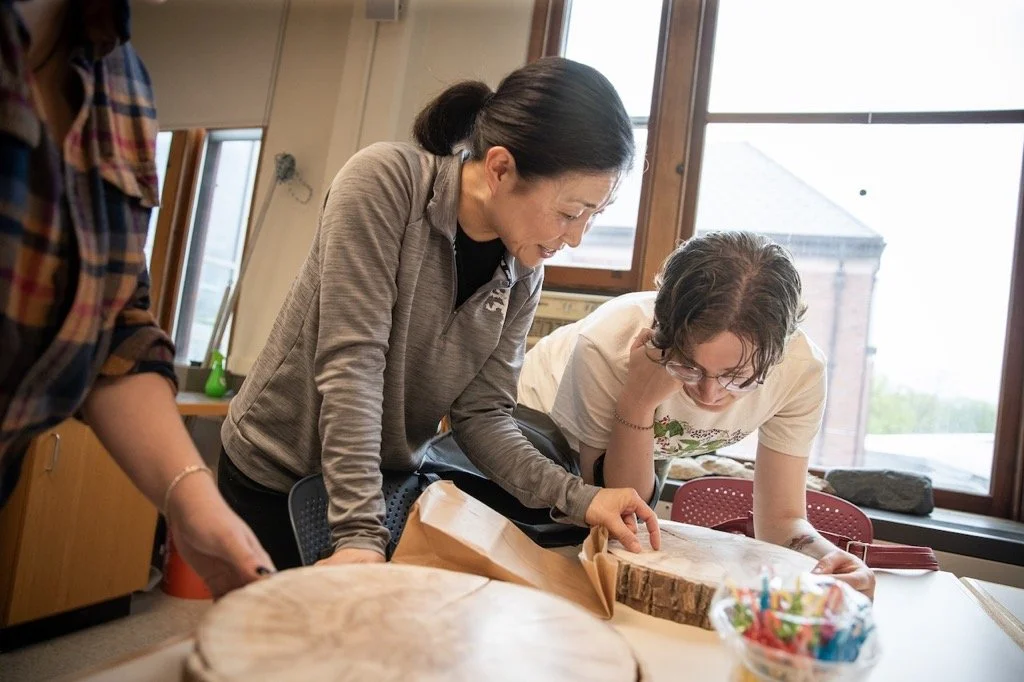
Visiting assistant professor Kinuyo Kanamaru explains the effects climate change has had on the beech tree, Tuesday, May 6, 2025. (Photo, Douglas Hook / The Republican)
BELOVED COPPER BEECH AT MOUNT HOLYOKE TELLS STORIES AFTER ITS DEMISE.
Article by Nicole Williams | Special to The Republican, published May. 11, 2025, by The Republican, a daily serving Western Massachusetts (online available at MassLive.com).
SOUTH HADLEY — In 1904, a Mount Holyoke College botany professor, Asa Kinney, planted a copper beech on the campus in honor of his new daughter, Elizabeth Kinney. The tree continued to grow for 120 years, including the time Elizabeth herself attended Mount Holyoke, stretching skyward to over 80 feet and gaining the nickname “the million-dollar tree.” Last year, the copper beech was critically damaged in a storm, requiring it to be taken down, to the dismay of many on campus. But its demise presented an unusual opportunity.
This semester, students in Prof. Kinuyo Kanamaru’s class studied sections of the tree to determine how climate change may have affected plants in the Pioneer Valley. The class used a dating technique called dendrochronology, in which patterns can be observed by examining the tree’s rings. Christian Feuerstein, the college’s director of public affairs and media relations, said that the copper beech became part of the college’s “living laboratory.”
Kanamaru, a visiting assistant professor in geology, is a sedimentologist who focuses her research on climate change, referring to herself as a paleoclimatologist. She said the project was spurred by students who wanted to know if the excess carbon dioxide in the atmosphere was resulting in happier trees. The class of 13 students sawed and polished sections of the tree into “cookies” to examine the effects of climatological information throughout the copper beech’s life. Events like a particularly cold winter in 1958 and Hurricane Irene in 2011 were labeled on the corresponding rings. These weather events, while severe, were brief and didn’t show a change in the width of tree rings on the copper beech.
The students did notice that over time, the growth rings started to become much narrower, with the wood becoming more brittle over the last 25 years. This change is believed to be caused by the tree facing long-term stress due to warming temperatures from climate change. Kanamaru said that when a tree is under stress, it is more vulnerable to fungus infections or bugs, affecting the overall health of the plant because the cell walls become thinner. Dark fungus spots can be seen on the copper beech, providing further evidence of its declining health.
“This was a very personal story for the copper tree,” said Kanamaru, who is hoping to continue this work with students by examining other trees in the area.... (click this link for the full article, and more pictures).
MHC FORWARD FUND for INTERNATIONAL STUDENTS
International students across the United States are facing unprecedented uncertainty and political challenges. More than 20% of Mount Holyoke undergraduates come from outside the U.S., forming a vibrant and truly global campus. We are proud of this diversity — and remain committed to protecting and uplifting our international students. These challenges threaten not only their education but also their sense of safety and belonging. As one student shared with The Boston Globe on May 28, 2025, “Mount Holyoke isn’t just where I study. It’s where I am safe. Right now, I’m scared to leave the country — but I know this community will fight for me to stay.”
Today, please consider three meaningful ways to help:
1. Make a gift to the MHC Forward Fund
This fund enables President Danielle Holley and College leadership to respond swiftly and compassionately to students’ needs. Your gift to this fund will:
• Offset the cost of summer housing, meals, support services and programming for international students.
• Provide essential legal support as the College navigates an increasingly hostile immigration environment.
• Uphold Mount Holyoke’s unwavering commitment to global citizenship.
This summer, 200 students are living on campus, about 40% of them are international. The cost of housing and meals for each student is approximately $350 per week, or $3,500 for the full summer. Your gift ensures these students have a safe place to stay, nourishment and community during a vulnerable time.2. Post a message on our international student Kudoboard
Share a message of care, solidarity or encouragement on our new Kudoboard for current and prospective international students. Your words will remind students they are not alone.
3. Visit our Forged in Dissent page, and share your story
By sharing your story, you help to strengthen our ability to defend the mission that shapes global citizens.
MHC recognizes that charitable giving to higher education is not common practice globally — but in this extraordinary moment, Mount Holyoke needs you. Every act of support sends a powerful message: We remain firmly committed to our international students and to doing what’s right.
Please consider making a gift and sharing your story today to ensure that every student has the opportunity to feel safe, supported and empowered to thrive — no matter the path that brought them to Mount Holyoke.
Submitted by Kassandra Jolley, Vice President for College Relations, MHC, June 2025
“We have the right to determine our own missions.”
The Boston Globe, April 9, 2025: “A handful of college presidents emerge as leaders of burgeoning resistance movement against Trump.”
See the article in 4 pages below.


MHC Forward: Updates From Leadership Webinar - January 28, 2025
Listen to Mount Holyoke President Danielle R. Holley and Vice President for Finance and Administration and Treasurer Carl M. Ries discuss the bold strides that the College is making and the plans that are emerging for our beloved campus.
The recording is available on THE GATES, Mount Holyoke’s community connections platform. If you have not already joined, sign up today. To access the recording on THE GATES, go to the “Resources” menu, then click on the “Webinars” menu.
https://thegates.mtholyoke.edu/hub/mountholyoke/resources/post/mhc-forward-updates-from-leadership

Frances Perkins,
MHC Class of 1902
President Biden Designates Frances Perkins Homestead as New National Monument
12/16/24 Heather Cox Richardson:
Today, President Joe Biden designated a new national monument in honor of Frances Perkins, secretary of labor under President Franklin Delano Roosevelt. The first female Cabinet secretary, Perkins served for twelve years. She took the job only after getting FDR to sign on to her goals: /unemployment insurance, health insurance, old-age insurance, a 40-hour work week, a minimum wage, and abolition of child labor. She later recalled: “I remember he looked so startled, and he said, ‘Well, do you think it can be done?’” She promised to find out.
Once in office, Perkins was a driving force behind the administration’s massive investment in public works projects to get people back to work. She urged the government to spend $3.3 billion on schools, roads, housing, and post offices. Those projects employed more than a million people in 1934.
In 1935, FDR signed into law the Social Security Act that she designed and negotiated, providing ordinary Americans with unemployment insurance; aid to homeless, dependent, and neglected children; funds to promote maternal and child welfare; and public health services.
In 1938, Congress passed the Fair Labor Standards Act, which established a minimum wage and maximum hours. It banned child labor.
The one area where Perkins fell short of her goals was in establishing public healthcare. It was not until 2010 that President Barack Obama signed into law the Affordable Care Act.
Heather Cox Richardson continued: https://heathercoxrichardson.substack.com/p/december-16-2024
12/16/24 National Parks Conservation Association Press Release (excerpt):
Frances Perkins was a trailblazing woman and pioneering advocate for social justice, economic security, and labor rights. Perkins was the first woman to serve in a presidential cabinet as Secretary of Labor under President Franklin Delano Roosevelt, becoming one of President Roosevelt’s closest and most highly regarded advisors. She fought for working people and served as a driving force behind the New Deal, helping to lift Americans out of the Great Depression.
The new Frances Perkins National Monument will be managed by the National Park Service. The designation comes after a successful grassroots campaign led by the nonprofit Frances Perkins Center and the National Parks Conservation Association (NPCA), urging the president to honor Frances Perkins’ legacy with a national monument.

Interview by Sheryl McCarthy ’69 (host of the CUNY TV show "One to One”) of President Holley:
